

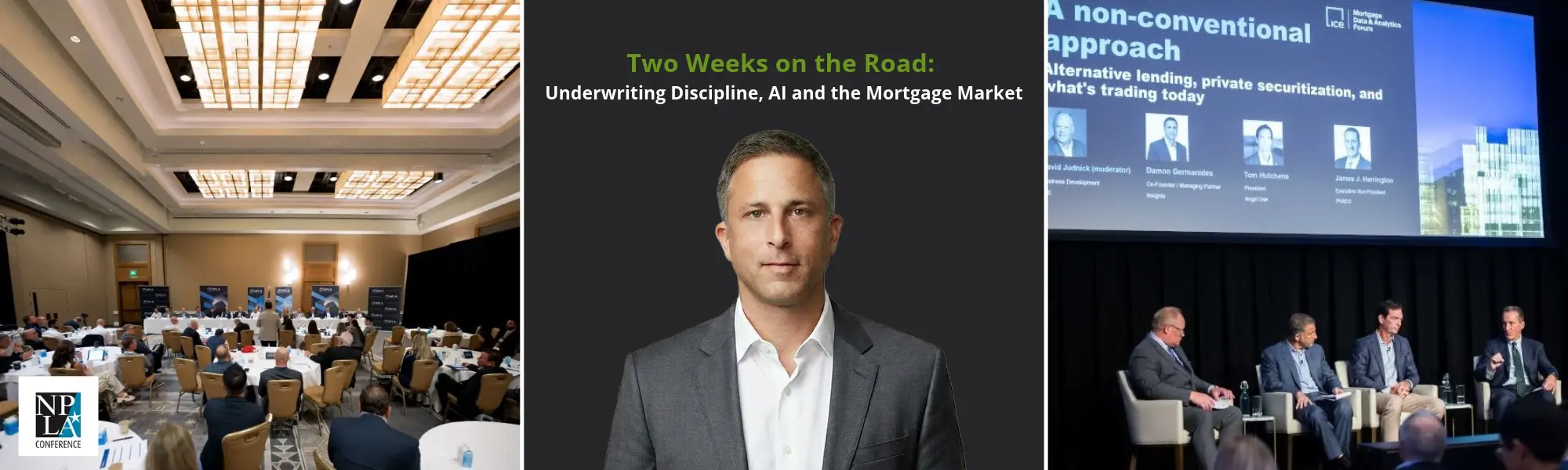
By Damon Germanides, co-founder of Insignia Mortgage and Insignia Capital Corp.
Two weeks of conversations at the National Private Lenders Association (NPLA) conference and the ICE Mortgage Data & Analytics Forum reinforced a consistent message: opportunities in mortgage and private lending require disciplined underwriting, a clear understanding of the borrower and careful execution.
At NPLA, discussions centered on credit risk, construction costs and realistic exit strategies. At the ICE forum, hosted at the New York Stock Exchange, I participated in an alternative lending panel and exchanged perspectives on non-QM lending, artificial intelligence and the forces shaping interest rates.
Across both events, my takeaway was similar: innovation can improve how we lend, but sound judgment remains essential.
Private Lending: Underwriting Discipline Comes First
The NPLA conference offered a valuable opportunity to compare experiences with lenders and other industry participants. One shift stood out: borrowers and lenders appeared more aligned in their outlook than they were six months or a year ago.
Previously, borrowers seemed more cautious while lenders remained relatively optimistic. Based on the conversations I had, that gap appears to be narrowing.
Recent interest rate movements, concerns around debt-service-coverage-ratio (DSCR) loans, housing conditions, elevated construction costs and changing demand patterns all figured into discussions about bridge lending.
Evaluate Leverage and the Exit Strategy Carefully
At Insignia Capital Corp., we have maintained a measured approach to underwriting, and DSCR lending is not a core focus. At the time of these discussions, we had not experienced the same pressures some peers described. Hearing their experiences nevertheless helps inform our own lending decisions.
My takeaway was straightforward:
- Be selective about increasing loan-to-value (LTV) or loan-to-cost (LTC) ratios.
- Reserve underwriting exceptions for the strongest credits.
- Scrutinize how the borrower plans to repay the loan.
For bridge and construction loans, the exit strategy deserves particular attention. A sale or refinance needs to remain credible if market conditions become less favorable.
Pressure can change behavior, making thorough due diligence especially important. We should not underwrite with the expectation that rising home prices will rescue a mistake.
AI in Mortgage Lending: Opportunity Requires Practical Execution
At the ICE Mortgage Data & Analytics Forum, artificial intelligence was a major topic of conversation.
My impression was that participants see meaningful changes ahead while recognizing that implementation will take time. Building useful systems, integrating them into existing operations and establishing a positive return on investment require substantial money, effort and judgment.
For mortgage businesses, the practical question is how that investment translates into better execution. The opportunity is significant, but so is the work required to make new technology useful within an established lending operation.
I came away encouraged by AI’s potential and mindful of the discipline needed to put it to work.
Interest Rates: Planning for a Range of Outcomes
Interest rates were another important discussion at the ICE forum.
Some participants on the capital markets side raised the possibility of a 10-year Treasury yield above 6%. This was discussed as a risk scenario, rather than a consensus forecast or a prediction of mortgage rates.
The conversation weighed the potential effects of substantial AI capital spending and fiscal pressures against AI’s longer-term potential to reduce costs and improve productivity.
There was no simple answer about which forces would dominate or when.
For borrowers and lenders, my takeaway is to evaluate financing decisions across a range of outcomes. A transaction should be assessed on its structure and ability to perform, rather than depend on a particular interest rate forecast proving correct.
Mortgage Credit: Different Segments Deserve Different Assessments
The broader tone around mortgage activity was subdued. Conversations reflected limited expectations for near-term growth, with participants describing pressure on homebuilder margins, tight spreads and intense competition for fewer transactions.
Credit performance was also part of the discussion. Participants raised concerns about Federal Housing Administration (FHA) mortgage and subprime auto delinquencies, including whether borrowers who fall behind are finding a path back to performing.
The assessment of Fannie Mae, Freddie Mac and non-QM credit was more reassuring, although emerging DSCR concerns drew attention.
These were observations shared in the room, rather than a comprehensive assessment of market-wide credit performance. They reinforced the importance of evaluating individual lending segments on their own characteristics.
Non-QM Lending and Complex Borrower Financing
With traditional mortgage volume constrained, firms are exploring additional lines of business. Conversations included home improvement financing, home equity lending and products that evaluate a borrower’s broader financial position.
That last area is familiar territory for us at Insignia Mortgage.
A pay stub or tax return does not always tell the full story for a business owner, real estate investor or borrower with substantial assets and complex income. Understanding that broader financial picture remains essential to structuring appropriate financing.
What Is Non-QM Lending?
Non-qualified mortgage, or non-QM, lending refers to mortgages that do not meet the qualified mortgage criteria. Depending on the program, lenders may evaluate income and repayment ability through alternative documentation, such as bank statements or qualifying assets.
Non-QM financing still involves underwriting. Eligibility, documentation and terms depend on the lender, loan program, property and borrower’s financial profile.
For borrowers with complex finances, the work begins with understanding how income, assets, liabilities and financing goals fit together. From there, we can evaluate which available lending options may be appropriate.
What These Conversations Mean for Borrowers and Referral Partners
I returned from both events with a renewed appreciation for disciplined underwriting, thoughtful innovation and the value of listening to experienced peers.
For borrowers considering a purchase or refinance, the rate is one part of a broader decision. Loan structure, documentation requirements and the experience of the team handling the transaction also deserve attention.
For brokers and referral partners, understanding a client’s full financial picture remains essential to identifying a workable financing path.
There are opportunities in this market. Pursuing them requires careful judgment and consistent execution.
Considering a purchase, refinance or complex financing scenario? Visit Insignia Mortgage to connect with our team.